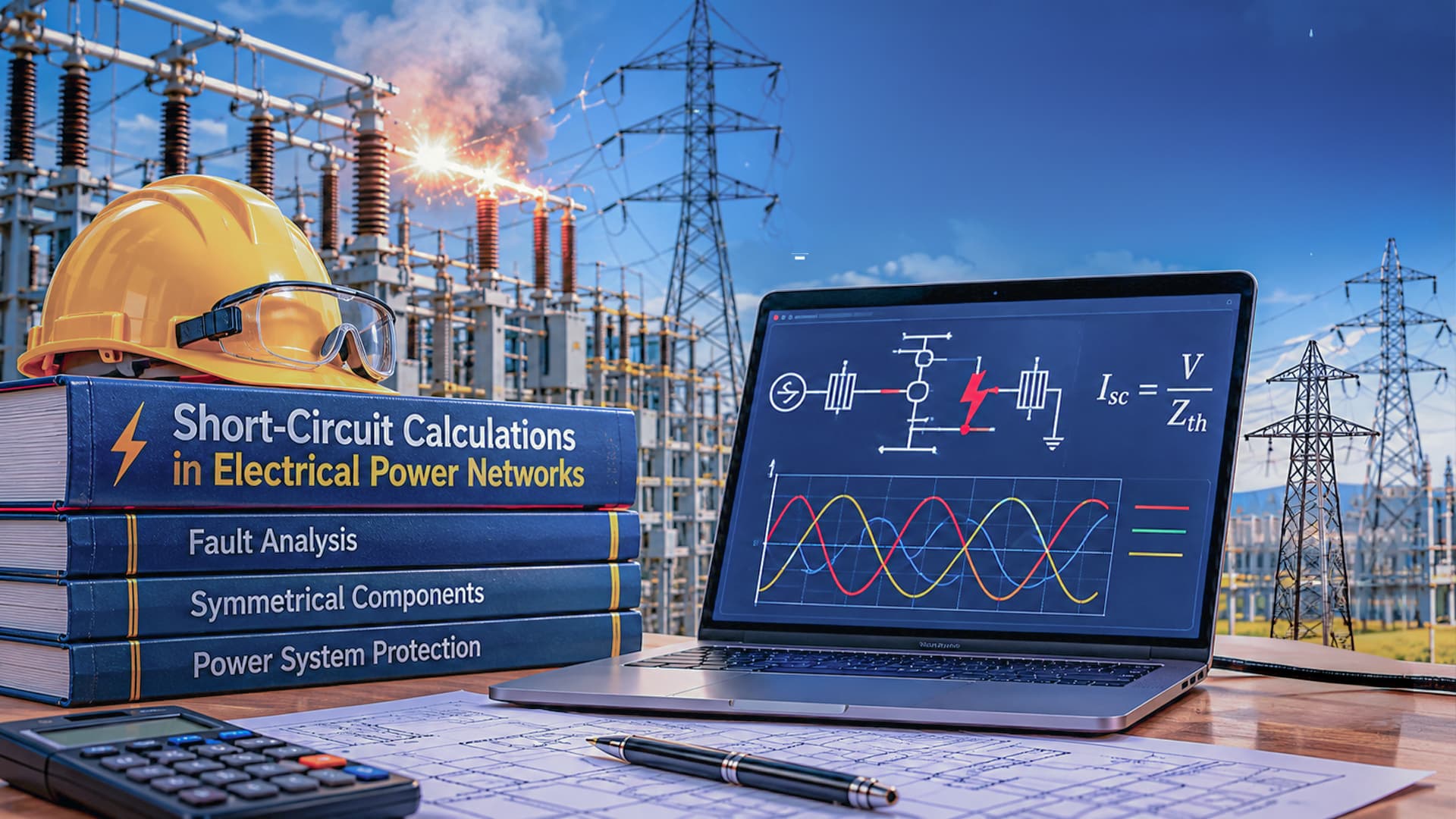
Short-Circuit Calculations in Electrical Power Networks
Short-Circuit in Electrical Networks حسابات قصر الدائرة
Faults, Per-Unit System, Circuit Breakers, Reactors, Symmetrical Components, Positive, Negative, Zero Sequence
- Rating
- New
- Level
- Advanced
- Length
- 3h 57m
- Lessons
- 39
- Taught in
- Arabic
What you’ll learn
- Types of Electrical Faults
- Importance of Short-Circuit Calculations
- Equivalent Circuit Assumptions
- Sources of Short-Circuit Current Supply (Local Generators, Synchronous Motors and Capacitors, Induction Motors)
- Asymmetry in Short-Circuit Currents
- Per-Unit System
- Rated Currents of Circuit Breakers
- Current Limiting Reactors (Generator Reactor, Feeder Reactors, Busbar Reactors)
- Motor Starting
- Ground Fault and Neutral Point
- Difference between Neutral Point and Earth Point
- Symmetrical Components
- Zero-Sequence Current VS Neutral C, AC or DC current?
- Sequence Impedances of Generators, Transformers, and Overhead Lines and Cables
- Zero-Sequence Networks
- Double-Line-to-Ground S.C
About this course
Through my practical experience (22 years) in the field of electrical substations for medium voltage (MV), high voltage (HV), and extra-high voltage (EHV), as well as working with various consulting offices in designing electrical distribution networks for many important projects that require accuracy in various electrical calculations, in addition to obtaining a Master's degree in Engineering Sciences in Power and Electrical Machines Engineering titled "Detection and Identification of Power Quality Problems using advanced Artificial Intelligence techniques (LSTM)", this course and these very important questions were prepared using the best engineering programs that connect academic/theoretical aspects with practical/reality in high voltage and extra-high voltage electrical substations, as well as distribution networks for medium and low voltages. This unique approach to explanation and question preparation has been designed to cater to all engineering and technical levels, starting from students in engineering universities and various technical institutes, all the way to highly experienced specialized engineers in power systems and electrical distribution. The course has been explained in a practical manner, relying on simplicity in theoretical explanations and placing greater emphasis on visuals and real-life practical examples. This approach allows us to connect academic theoretical study with what actually exists in practical reality for real-world application after completing this course. The course we have is closely related to the power systems and electrical distribution systems. In this course, we provide the following: Short-Circuit Current Calculations in Electrical Power Networks * The basics of short-circuit current calculations in electrical power networks. * The types of electrical faults that can occur in the electrical network. * differentiate between symmetrical and unsymmetrical faults. * The importance of short-circuit current calculations and the key factors that influence them * discuss the assumptions used in constructing the equivalent circuit of the electrical network during a short-circuit condition * The sources of short-circuit current supply (utility system, local generators, synchronous motors and capacitors, induction motors) * How we can calculate the asymmetric short-circuit currents * The importance of using the Per-Unit System in electrical network calculations instead of using actual quantities * The Rated Currents of Circuit Breakers * The Current limiting reactors (generator reactor, feeder reactors, busbar reactors, * Motor starting * The role of the neutral point in determining the behavior of the electrical network during a ground fault * The difference between the neutral point (N), and the Ground point or the earth point (E). * The Symmetrical Components theory * The difference between Positive Sequence, Negative Sequence, and Zero Sequence. * The difference between the zero-sequence current and the neutral current. * Is the zero-sequence current AC or DC? * The positive-sequence current, negative-sequence current, and especially the zero-sequence current in star and delta connections. * Sequence impedances (generators, transformers, overhead transmission lines and cables)
Course content
4 sections · 39 lessons · 3h 57mBasic Concepts
5 lessons · 32 min- 0101 Course Preview & Contents 16 minIn trial
- 0202 Introduction4 minIn trial
- 0303 Types of Electrical Faults6 minIn trial
- 0404 Importance of Short-Circuit Calculations3 min
- 0505 Equivalent Circuit Assumptions4 min
Sources of Short-Circuit Current Supply
11 lessons · 55 min- 0606 Introduction2 min
- 0707 Utility System6 min
- 0808 Example (1)4 min
- 0909 Local Generators4 min
- 1010 Synchronous Motors and Capacitors2 min
- 1111 Induction Motors2 min
- 1212 Asymmetry in Short-Circuit Currents5 min
Practical Applications
11 lessons · 1h 22m- 1717 Introduction2 min
- 1818 Rated Currents of Circuit Breakers4 min
- 1919 Example (5)31 min
- 2020 Current Limiting Reactors3 min
- 2121 Generator Reactor2 min
- 2222 Feeder Reactors3 min
- 2323 Busbar Reactors4 min
Ground Fault and Neutral Point
12 lessons · 1h 8m- 2828 Introduction2 min
- 2929 Difference between Neutral Point and Earth Point3 min
- 3030 Symmetrical Components – 115 min
- 3131 Symmetrical Components – 27 min
- 3232 Zero-Sequence Current VS Neutral C, AC or DC current?12 min
- 3333 Sequence Impedances of Generators2 min
- 3434 Sequence Impedances of Transformers2 min
Earn a certificate
Finish every lesson to earn a LearnU certificate with your name, ready to download and share on LinkedIn.
Included with the membership and with this course